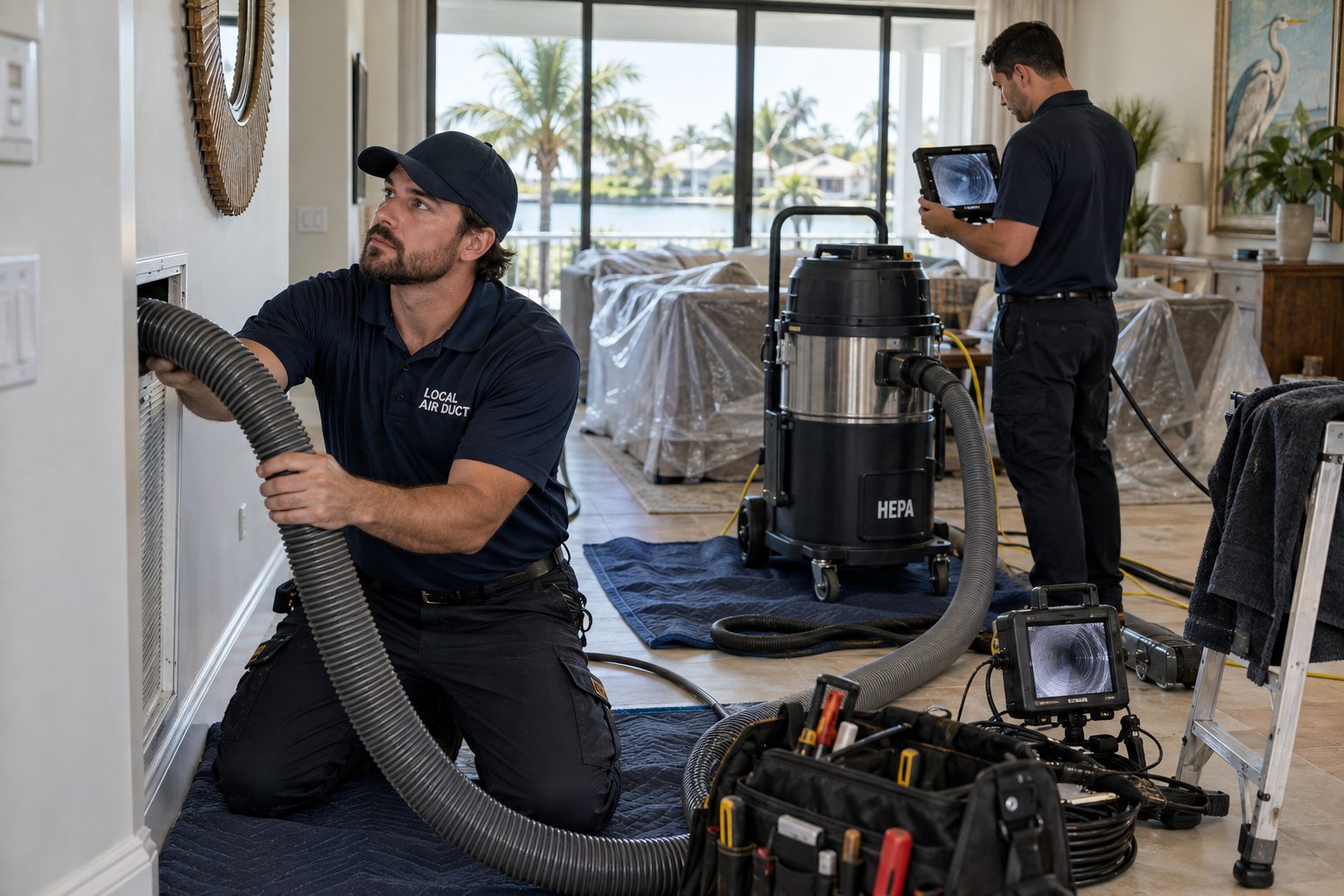
Why humid air changes what builds up inside ducts
South Florida runs its cooling equipment for most of the year, and that single fact shapes everything about the inside of a duct system. Air conditioners do not only cool the air, they pull water out of it. Every hour the system runs, moisture collects on the coil and drains away, and some of that dampness lingers on surfaces nearby.
Dust that enters a damp environment behaves differently from dust in a dry one. In a dry house it stays loose and can be vacuumed away easily. In a humid house it can cling to duct walls, mat together with lint and pet hair, and form a layer that holds on. That is one reason people in Fort Lauderdale often find ducts dirtier than they expected.
None of this means every system is in trouble. Plenty of ducts are perfectly serviceable after many seasons. It simply means that the question of cleaning deserves a real look instead of a guess, and that a calendar alone is a weak reason to book work. This page is general guidance, written for anyone in the city thinking the question through.
What a dirty duct system actually looks like
People often imagine ducts as hollow metal tubes with a thin film of dust. In real homes the picture is more varied. Many residential systems use flexible round duct with a plastic liner, wrapped in insulation, and that liner has ridges where debris settles. Others use sheet metal trunks with branch lines, and still others use a duct board plenum near the air handler.
In a system that needs cleaning you might see grey felt like fuzz along the floor of a trunk line, a crust of dust around the edges of supply registers, or dark streaks on the ceiling near a vent. Return grilles can be worse than supplies, because they sit at the start of the path where the air carries the most lint and hair.
Camera work also lets you see inside a duct without cutting into anything, and you can ask to look at the footage with the technician as it plays. A cleaner can only describe what is true when they can see it. That is why the first step is an inspection with a light and a camera rather than a sales pitch. If the inside looks light and dry, the honest answer may be that cleaning is not urgent. If it looks heavy, you will see the proof yourself.
The point of looking first is to match the work to the actual system, not to a generic package.
Signs worth acting on in a Fort Lauderdale property
Some signals are fairly reliable. Dust that returns on furniture within a day or two of wiping, even with the windows closed, suggests that the air moving through the house is carrying debris. Visible dust blowing out of a register when the system starts is another. A musty smell when the air conditioner kicks on, especially after the house has been closed up, deserves a closer look too.
Other signs are about airflow rather than dirt. If one bedroom stays warm while the rest of the house is comfortable, the cause could be a crushed flex line, a disconnected joint, a closed damper, or heavy buildup. Cleaning will not repair a disconnected duct, so the symptom should be described honestly when you call so the inspection looks for the right thing.
Renovation is a common trigger. After drywall sanding, tile cutting, or any messy remodel, fine dust can enter open returns and settle in the trunk lines. Moving into a place that sat closed for a season is another. In both situations a camera check before and after the work gives you something concrete to compare.
- Dust returns to surfaces soon after wiping them down.
- Registers show visible fuzz, grey crust or dark streaks around the edges.
- A musty smell appears when the system starts after the house has been shut up.
- One room stays warm or feels weak compared with the others.
- The home has recently been remodeled, or was empty for a long stretch.
Dust, debris and the mold question
Many callers use the word mold when they mean dust, and the reverse happens too. Dust is dry and powdery and usually grey or tan. Suspected mold tends to look fuzzy, spotty or slimy, often in black, green or white patches, and it usually points to a moisture source such as a leaking drain pan, a sweating duct, or insulation that has gotten wet.
This difference matters because cleaning removes debris, but it does not fix the reason moisture is present. If a duct is sweating because the insulation is damaged, wiping it clean will only buy time. The cause has to be found, and sometimes that means repair or sealing work as covered on the duct repair and sealing page.
If you see something that worries you, do not scrub it or spray it yourself and do not run the system hard while you wait. Describe what you saw, where it was, and when you noticed it. Photographs taken with your phone help. An inspector can then decide whether the next step is cleaning, repair, testing, or a combination, and explain the reasoning before anything starts.
How the inspection sets the scope
A good scope grows out of the system, not out of a price list. During the visit the technician looks at the air handler, the plenum, the trunk lines and a sample of branches and registers, noting the duct material and any damage. They also check the return path, because a dirty return is often the real source of what lands in the supplies.
From that, the work is described in plain terms. Which parts of the system will be cleaned, how access will be made, what will be protected in the house, and what will be left alone. If the inspection finds a problem that cleaning cannot solve, such as torn liner or a broken connection, that gets said out loud instead of being buried in a bundle.
Our process is intentionally simple. You call and describe the property and what you are noticing. The system is inspected. The scope and price are explained before any work begins. Before and after photos and a final check are shared with you at the end. The air duct cleaning scope guide walks through the same logic in more depth if you want to read it before calling.
What cleaning covers and what it leaves alone
Duct cleaning for a home generally means creating negative pressure on the system, agitating the surfaces so debris lets go, and drawing that debris out into a contained collection point. Brushes, air whips and compressed air tools each suit different duct types. The method should match the material, because aggressive tools on thin flex liner can do real damage.
The scope usually includes supply and return runs, registers and grilles, and the accessible parts of the plenum. The blower compartment and evaporator coil are a separate subject with their own tools and cautions, which is why coil and blower cleaning is listed as its own service. Ask whether it is part of the plan you are being given.
What cleaning does not do is as important. It does not seal leaks, replace worn insulation, fix an undersized system, or cure a poor filter habit. A duct system that is cleaned and then fed unfiltered return air through a leaky return will be dirty again sooner than anyone would like, so honest advice often includes a look at filters and returns too.
Thinking through timing across the cooling season
Because the air conditioner is rarely off for long in South Florida, there is no truly idle season in which the ducts sit still. That changes how people think about timing. Instead of waiting for a mild month, most owners choose a time when the household can handle a few hours of activity, when someone can be present, and when the equipment is behaving normally.
A system that has just developed a problem is a poor candidate for scheduling around convenience. If the unit is short cycling, leaking water, freezing or blowing warm air, the equipment needs service first. Cleaning ducts while a mechanical fault is active only hides the picture, and the technician will probably ask you to have the fault addressed before the cleaning is done.
If you are buying, selling or renting out a property, the timing question has an extra edge. A documented inspection with photographs gives a buyer, a tenant or a property manager something concrete to look at. It also gives you a clear before and after record that you can keep with your property file, whatever you decide to do next.
Finally, think about what else is happening in the house. Painters, flooring crews and drywall repair all stir up dust. If a project is coming, it usually makes more sense to finish it first and clean afterward, so the ducts are not loaded with fresh construction dust a week later.
Condos, townhomes and shared building questions
Fort Lauderdale has a wide mix of housing, from single family homes to condominiums and townhomes. In multi unit buildings, the air handler for your unit may sit in a closet, an attic space, or a mechanical room, and access can involve the association or building management. Requirements and rules vary, so ask your association or manager what they expect before a visit is scheduled.
It also helps to know whether your unit has its own air handler or shares a system. Ducts that serve one unit are usually straightforward. Anything shared across units is a building level decision, and cleaning it is not something one owner can authorize. Say which situation you have when you call so the visit is planned properly.
Occupied properties are normal for this work. Technicians are used to working around furniture, kitchens and people. Clear a path to the air handler, move fragile items away from the registers, and tell the technician about pets or anyone who is sensitive to dust, so they can protect the space and keep the work tidy.
Dryer vents and coils belong in the same conversation
When people call about ducts, the house often has other airflow problems that nobody mentioned. A dryer vent clogged with lint is a safety issue as well as an efficiency one, because lint is flammable and a restricted vent traps heat. If clothes take multiple cycles to dry, or the laundry room feels hot and smells of warm lint, that deserves attention. The dryer vent cleaning page explains what that visit involves.
The evaporator coil is another quiet contributor. A coil coated in dust and film cools poorly, holds more water, and can feed musty odors into the airstream. If the air handler has been neglected, the duct cleaning only addresses half the story.
You do not have to do everything at once. The inspection can rank the findings so you can decide what matters now and what can wait. Some owners choose duct cleaning first and handle the rest later. Others bundle the work because access to the air handler is already open. Either way the decision should be yours, with the facts in front of you.
Keeping the system cleaner between visits
The most effective habit is the dullest one: a clean filter of the right size, installed correctly, and replaced on a schedule that fits your household. Homes with pets, shedding, smokers, or lots of foot traffic load filters sooner than quiet homes. A filter that is crushed, bent, or the wrong size lets air go around it, defeating the point.
Keep supply registers and return grilles clear of furniture and rugs, and wipe grilles when you dust. Make sure the closet door around the air handler seals properly, because a gap lets dusty closet air get pulled into the return. Keep windows closed when the air conditioner runs, especially when outdoor humidity is high.
If you notice water around the air handler, a drain line that keeps clogging, or ice on the coil, treat those as system problems and call for service on the equipment itself. Cleaning ducts is one part of maintaining comfort and air quality. It does the most good when the equipment, filters and ducts are all in reasonable condition.
Think of the system as a chain. The return grille pulls in air, the filter catches what it can, the blower pushes the air across the coil, and the ducts carry it to each room. A weak link anywhere changes how long the other parts stay clean. Owners who understand this tend to make steadier decisions, because they stop expecting one service to solve every comfort complaint.
Photos, the final check and what to ask before you book
Before and after photos are the simplest form of proof. They show the interior of the same runs in the same places, so you can judge the difference without taking anyone's word for it. A final check confirms that registers are back in place, panels are closed, the system runs normally, and the work area is left tidy.
Before you book anyone, ask a few direct questions. What will the inspection include? How will the scope be explained? What method suits my duct material? Will I see photos before and after? What is outside the scope? Clear, unhurried answers are a good sign, and vague ones are worth noticing.
Do not be shy about asking for the plan in plain words. A trustworthy explanation names the parts of the system being cleaned, the parts being skipped and the reason for each choice. It should not rely on jargon, and it should not change at the door. If the scope shifts after the inspection, you should hear why before anyone starts.
You can also compare this page with the nearby guides, such as air duct cleaning in Fort Lauderdale and duct inspection in Fort Lauderdale. Neighbors in Hollywood and Plantation face similar questions, and the service area page shows where work is done.
Common questions
How do I know if my ducts really need cleaning?
Look for dust that keeps returning, visible fuzz or crust at registers, a musty smell at startup, or uneven airflow between rooms. None of these alone settles the question. An inspection with a light and a camera shows the inside of the system, so the decision rests on what is actually there rather than on a calendar date.
Will cleaning fix a room that never gets cool?
Sometimes, but often not. A warm room can come from heavy buildup, but it can also come from a disconnected or crushed duct, a closed damper, or a system that was never sized well for that room. Describe the symptom when you call so the inspection checks for the likely causes, not only dirt.
Is it safe to stay home while the work is done?
Yes, this is normal in occupied properties. The technician protects floors and furniture near the work and keeps the area tidy. If someone in the household is sensitive to dust, has breathing concerns, or there are small pets, mention it in advance so the plan can account for it and everyone can stay comfortable.
What is different about condos and townhomes?
Access and authority. The air handler may be in a closet, attic space or shared mechanical area, and a building may have its own expectations. Rules vary, so check with your association or building manager. Be clear about whether your unit has its own air handler, because shared systems are a building level decision.
Does duct cleaning replace changing my filter?
No. The filter is your first line of defense and works every hour the system runs. Cleaning removes buildup that has already settled, but a poor or missing filter will let new debris in again. Use the right size, install it facing the correct direction, and replace it on a schedule that suits your household.
What if the inspection finds mold or damage?
You will be told what was found and shown it. Cleaning removes debris but does not cure a moisture source, so the plan may also involve repair, sealing, or further testing. Nothing starts until the scope and price are explained to you, and you decide whether to proceed, wait, or get another opinion.