Home › Services › Air Duct Cleaning
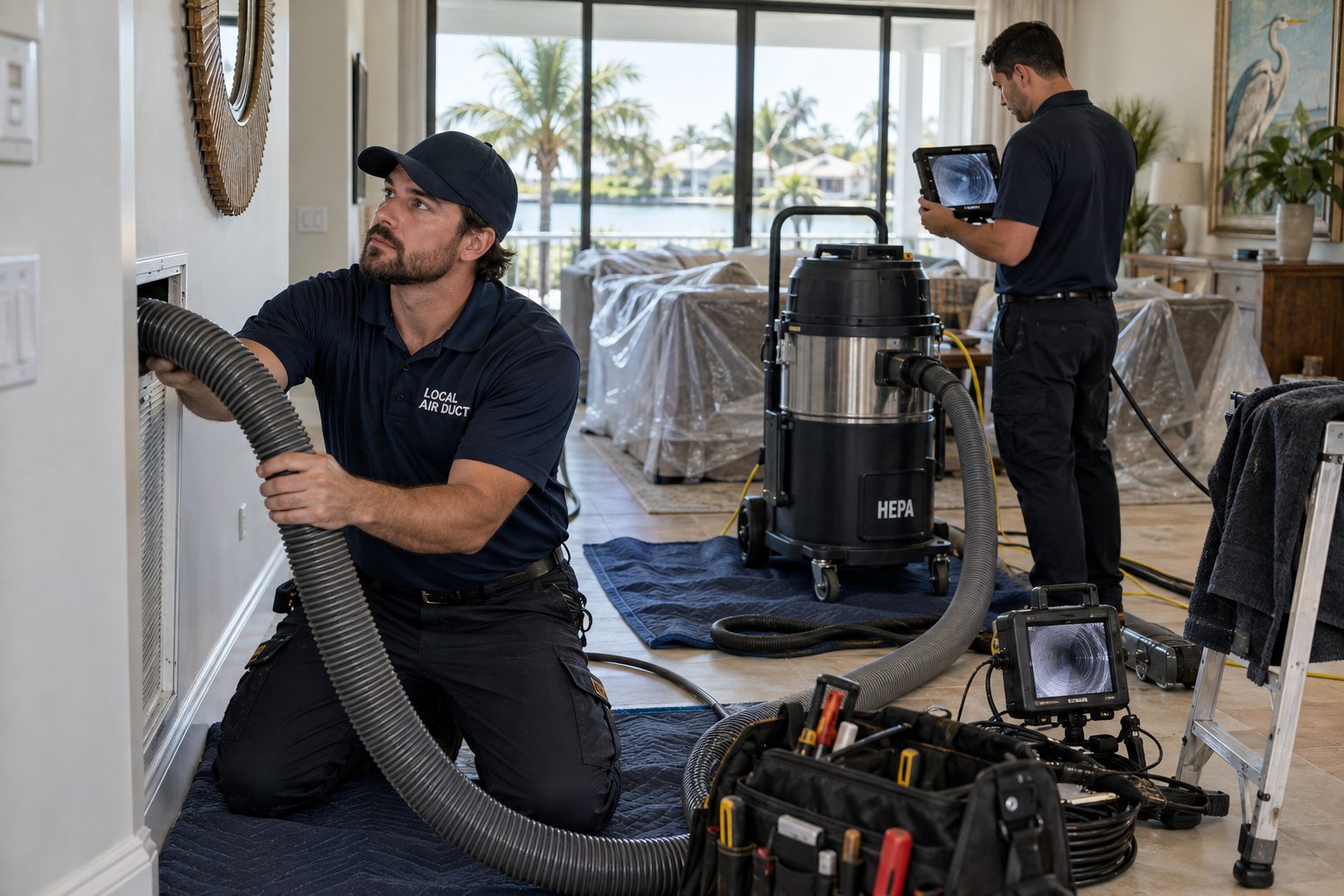
Every supply and return run cleaned under negative pressure, with rotating brushes agitating what's built up on the walls of the duct. The debris is pulled out of the system, not just knocked loose and redistributed.
Serving Broward, Palm Beach and northern Miami-Dade counties. Every job documented with before-and-after photos. Call (954) 686-6201.
The inside of the system documented before we start , a before picture, not a claim.
The system sealed and put under negative pressure so nothing escapes into the living space.
Rotating brushes loosen buildup, a vacuum source pulls it out.
An after picture taken from the same access points, so the result is visible, not just described.
The ducts in a building are a network of passages that carry air from the air handler out to every room and back again. Supply ducts push cooled air to the registers, and return ducts pull room air back to be cooled again. In between sit the filter, the blower and the coil, which condition the air as it passes.
Over time, anything that gets past the filter ends up on the inside of that network. Fine household dust, pet hair, lint, pollen, cooking residue and construction powder all travel with the air, and some of it settles on duct walls. In a humid climate with long cooling seasons, damp surfaces catch that material more readily, so a film can form that is stickier than dry dust.
Mixed building ages across South Florida add variety, since older metal systems, flexible duct and newer lined duct all collect and hold dust differently. That film is not automatically a problem. A light, even layer is normal in any system that has been running for a while. The question is whether the buildup is heavy enough to restrict airflow, whether it is mixed with moisture, and whether it is likely to be blown into living spaces. The only way to answer is to look, which is why an inspection comes before any cleaning.
Several everyday observations can point toward a buildup inside the system. Dust that returns to furniture within days of wiping, visible dust or debris at the supply registers, dark streaks around vent openings and a stale smell when the air conditioning starts are all common reasons for a call. So is a recent renovation, since fine construction powder is easily drawn into the returns.
Some signs point to a different problem. A room that is always warm may have a collapsed or disconnected duct, not a dirty one. A damp smell may come from a clogged drain pan, not from dust in the supply runs. Water stains on a ceiling may mean wet insulation. Cleaning is the right answer to buildup and the wrong answer to a broken duct, which is why the inspection sorts the two. Describing the room, the time of day and the season when the problem is worst gives the technician a head start on telling them apart, and costs you nothing but a minute of thought.
If someone in the household has health concerns about indoor air, it is reasonable to ask about the condition of the system, but cleaning should not be presented as a medical remedy. Ducts are one of many sources of dust and allergens in a home. A careful company will say so, and will suggest talking to a healthcare professional about symptoms.
Timing also deserves a thought. If you plan a renovation, finish the dusty stages first and clean afterward, so the ducts are not filled again by the next round of work. If you are about to move in, an inspection before furniture arrives gives the technician clear access and gives you a baseline for the life of the system. If you are preparing to sell, photographs of a clean, well documented system can reassure a buyer.
Before any cleaning, the system is inspected from the registers to the equipment. The technician looks at the return grilles and filter slot, the blower compartment and the coil, the supply plenum and the accessible branch ducts. A light and a camera show conditions in places that cannot be seen directly, and photographs record what is found.
The inspection answers three questions. How much buildup is there, and where is it? Is anything damaged, disconnected or wet? What could not be reached? The answers shape the scope of work, and they are explained to you in plain words, together with the photographs that support them.
Contact starts with a phone call. You describe the property, whether it is a house, condo or townhome, and the symptom that prompted you to call. That conversation tells the technician what access to plan for and which parts of the system to examine first. Nobody can responsibly name a diagnosis over the phone, so the first visit is about looking, not selling.
If the inspection shows a light film and nothing else, the honest recommendation may be to leave the ducts alone and change the filter regularly. If it shows heavy coating, damaged insulation or leaks, the recommendation will reflect that. In every case, the scope and price are explained before any work begins, and you can say yes, no or not yet.
A thorough cleaning treats the system as a whole. Access openings are made where needed so that the supply and return runs can be reached. Debris is loosened from duct surfaces using agitation tools, brushes or compressed air, and it is pulled out by a powerful vacuum connected to the system, so the material is captured instead of being released into the house.
The registers and grilles are removed and cleaned, the accessible portions of the plenum and trunk lines are treated, and the interior of the air handler is addressed as far as is practical. Dirty equipment is covered in more detail under coil and blower cleaning, because the coil and blower can be a service of their own.
The technician protects floors and furniture near the work areas, keeps hoses and tools out of walkways and closes up access points when finished. The property stays occupied during the work in most cases. If an area cannot be reached safely, it is named in the findings, not skipped without a word.
Expect the process to take care and attention instead of a hurried pass. A system with several branches, a long return and a large air handler involves many access points, and each needs to be dealt with and closed properly. Ask the technician to walk you through what was done in each part, and to show the photographs at the end.
A duct that leaks or has come apart behaves like a hole in the system. Cooled air escapes into the attic or wall cavity, and unfiltered air from those spaces gets pulled in. Cleaning a duct that is pulling in attic dust through a gap gives a short lived result, because fresh dust arrives as soon as the system runs again.
For that reason, the inspection looks at joints, boots and connections as carefully as it looks at buildup. Where faults are found, duct repair and sealing reconnects and seals the system, either before the cleaning or alongside it. The technician explains the order and the reason.
Insulation matters here too. Torn or wet wrapping lets ducts sweat in a hot attic, and the moisture feeds dust and growth. If that is the situation, attic and duct insulation belongs in the plan. Cleaning without fixing the source is like mopping a floor under a leaking pipe.
Dark patches inside a duct raise an understandable worry about mold. Telling mold from dark dust by eye is unreliable, even for experienced technicians. The honest approach is to photograph what is seen, describe it without labeling it, and recommend sampling if you want a firm answer.
Indoor air quality testing can provide that answer. It collects samples and reports what is found, which is more useful than a guess. It also helps you decide whether the situation calls for cleaning, sanitizing, repair or a different kind of attention.
Whatever the result, the moisture source has to be addressed. A clogged drain pan, a leaking joint or wet insulation will bring the problem back. Cleaning removes what has built up; it does not stop new moisture from forming, and no honest technician will claim it does.
People sometimes ask whether the air in the house will smell different afterward. Often there is a modest change, particularly if a stale smell came from dust in the returns. If a smell persists, the cause may be elsewhere, such as the drain pan, damp insulation or a source in the home itself. Say so at the final check, so the technician can look at the likely places before leaving.
Some customers want an additional treatment after cleaning. Sanitizing treatment is a separate service applied to cleaned surfaces, and it is optional. It should follow cleaning, not replace it, and it makes sense only when surfaces are dry and the moisture source is under control.
Ask the technician what would be applied, where, and what precautions apply for people and pets. A clear answer is part of a trustworthy offer. Vague language about killing everything is a signal to ask more questions.
You are welcome to decline add ons without affecting the rest of the job. A good company explains the options and leaves the decision to you.
The simplest test of a cleaning is the photographs. Before and after images taken from the same location, in the same direction and in good light, show the change clearly. Our before and after photo guide explains what to look for, such as visible surface, matching angles and enough detail to see texture. Be wary of photos that change angle, lighting or distance between the pair, since those differences can make almost any surface look better or worse than it is.
Compare the work with the scope you were given. If the scope listed supply runs, return runs, registers and the air handler, there should be photographs and notes for each. If an area was not reached, the notes should say so. The scope guide lists the parts of a system a thorough job normally covers, which helps you compare one quote with another.
The final check happens before the technician leaves. Walk through with them if you can. Look at the registers, make sure panels are closed, and ask about anything that seems off. Raising a concern at that moment is much easier than a day later.
A little preparation makes the visit smoother and the result better. Clear a path to the air handler and to any attic hatch or closet panel, and move stored items away from vents and returns. If furniture sits directly under a ceiling register or against a wall register, shift it a few feet so the technician can work and so nothing is bumped.
Keep pets and small children away from the work area. Hoses, brushes and ladders are poor company for a curious animal, and open access panels are exactly the kind of thing a cat will investigate. If you have an indoor pet that is nervous about noise, plan a quiet room with the door closed.
Think about who will be home. Someone should be present to open doors, point out the rooms that concern you and look at the photographs afterward. If you are a landlord, give your tenant notice and explain what will happen. In a condo or townhome, ask the manager or association about access and work hours, since requirements vary.
It helps to be realistic. Cleaning will not repair a broken duct, replace torn insulation, fix an undersized system or make an old air handler perform like a new one. It will not stop pollen from entering the home when doors open, and it will not remove dust that is sitting on furniture or carpet.
Cleaning also cannot make a promise about the future. A system that is cleaned and then ignored will collect dust again, at a rate that depends on the filter, the household and the climate. The right way to think of it is as a reset, followed by good habits such as regular filter changes, closing up gaps and fixing moisture problems promptly.
If someone promises that a single cleaning will solve every comfort or health issue in the house, be cautious. Honest companies talk about what the work does, what it does not do and what else might need attention. That honesty is a good sign, and it is the standard to hold anyone to.
There is also the matter of what happens between cleanings. Changing the filter on a sensible schedule, keeping return grilles clear and fixing small leaks promptly all slow the return of buildup. None of this is complicated, and none of it needs special tools. Households that keep these habits tend to find that an inspection later shows a much lighter film than they feared.
If you are searching for a local option, the page on air duct cleaning near me explains how the service is arranged, and the service area page lists the cities covered, such as Fort Lauderdale, Hollywood and Pembroke Pines.
Each city page is general guidance and does not describe local rules or past work in the area. Requirements about access, work hours and shared systems vary by building and association, so check with your manager or local office before booking.
For the full list of options, see the page on every service. Many properties benefit from combining duct cleaning with another service, and the order of work matters. Ask the technician to explain the sequence and the reasons for it before you agree.
Look for dust that returns soon after wiping, debris at the registers, dark streaks near vents or a stale smell when the system starts. None of these is conclusive on its own. An inspection shows how much buildup there is and whether another problem, such as a leak, is the real cause.
Sometimes, if the cause is heavy buildup restricting airflow. More often an uneven room points to a leak, a kinked or disconnected duct or a clogged coil. The inspection finds the cause, and the technician explains whether cleaning, repair or both are the right answer.
The property usually stays occupied. Floors and furniture near work areas are protected, hoses are routed carefully and access points are closed up afterward. Expect some noise from the vacuum equipment. Keep pets in another room and make sure someone is present for the walkthrough.
That cannot honestly be promised. Ducts can carry dust, dander and pollen, so a heavily coated system may contribute, but symptoms have many causes. Talk to a healthcare professional about symptoms, and treat any cure claim from a service company with caution.
If something looks like growth, the technician photographs it and explains what was seen without labeling it. Testing gives a firmer answer. The moisture source must also be fixed, since cleaning alone will not stop it from returning. You decide what to do after hearing the scope and price.
Compare the before and after photos, check that they match locations, and read them against the scope you agreed. A final check is made before the technician leaves. Anything not reached should be named in the notes. Ask questions at that moment, while the work is fresh.
Website content was prepared with AI assistance and reviewed for clarity. Service recommendations depend on an on-site assessment.
Tap to Call , (954) 686-6201