Home › Services
Ten things, done properly, with photo documentation on every job. Call (954) 686-6201.
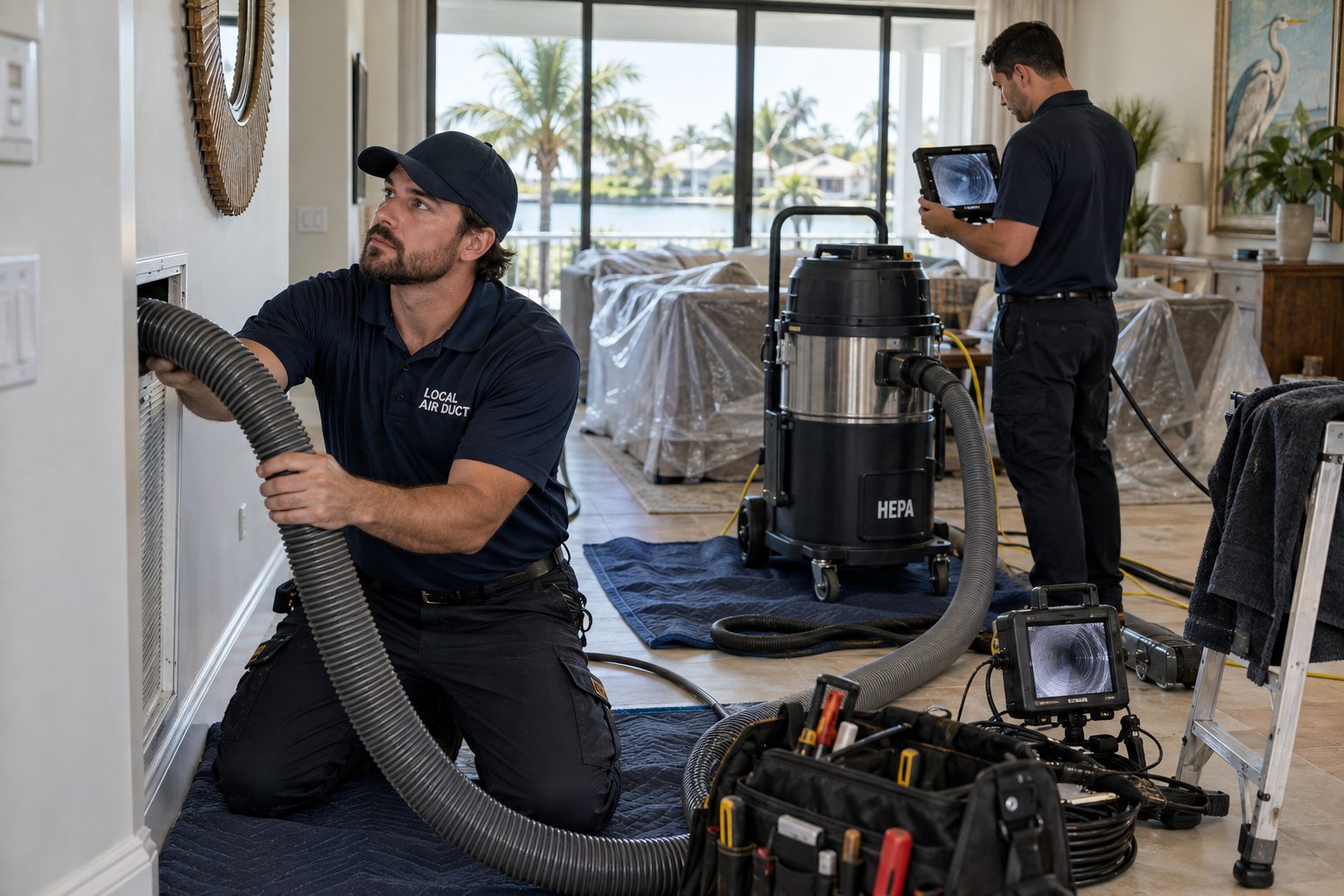
Supply and return runs cleaned under negative pressure with rotating brushes, so debris leaves the system instead of relocating inside it.
Lint packed in a dryer line is a genuine fire hazard and it lengthens every cycle. We clear the full run and verify airflow at the exterior hood.
EPA-registered antimicrobial fogged through cleaned ductwork to address what humidity has been growing in the dark.
Evaporator coil and blower wheel cleaned, the two components that quietly destroy airflow and efficiency when loaded with dust.
Restaurants, offices and multi-unit buildings serviced on a schedule that doesn't shut the business down.
Leaking, disconnected, or crushed ductwork found and sealed properly, so conditioned air actually reaches the rooms it was meant for instead of the attic.
Particulate, humidity, and airflow measured at the register so an air-quality complaint gets a real answer instead of a guess.
Exposed or under-insulated ductwork in the attic wrapped and sealed, cutting the energy loss that happens before air ever reaches a room.
Most people do not call with a service name in mind. They call because a room is warm, a smell appears when the air conditioning starts, the dryer takes two cycles to dry a load, or dust keeps coming back. Behind each of those symptoms there may be one cause or several, and the service that fits depends on what is found.
That is why the process starts with a conversation and an inspection, not a price list. The company does not guess at a diagnosis over the phone, and you should be wary of anyone who does. You describe the property and the symptom, the system is inspected, and the findings are explained. Only then does anyone propose a service, and the scope and price are explained before work begins.
This page is a map of the options. Read it to understand what each service is for, what it does not do, and how services fit together. Then call, describe what you notice, and let the inspection narrow things down.
Humid weather and long cooling seasons shape every one of these services. Air conditioning in South Florida runs for most of the year, so coils, drain pans, ducts and insulation spend months cold and damp. Properties also vary: condos, townhomes, older houses and newer buildings each pose their own access questions. Occupied homes are the normal case, and the work is planned around the people who live there.
Duct cleaning removes dust, debris and buildup from the inside of the supply and return ducts, the registers and the parts of the air handler that can be reached. The point is to restore clean airflow paths and take out material that has collected over time. Our page on air duct cleaning describes the work step by step.
It is a good fit when an inspection shows heavy coating on duct surfaces, after construction or remodeling dust has been drawn into the system, or when a property has been vacant for a long period. It is not a repair, so if ducts are leaking or disconnected, cleaning alone will not hold, and sealing needs to come first or alongside it.
Because the phrase duct cleaning can mean quite different amounts of work, our scope guide lists what a thorough job should include. Use it to compare what you are offered with what you are actually paying for.
Expect the technician to open access points where needed, to clean the supply and return runs that can be reached, and to treat the registers and the accessible parts of the air handler as part of the job. Areas that cannot be reached should be named, not ignored. Before and after photos then show the same locations, so you can judge the difference for yourself.
The dryer vent is a separate path from the air conditioning ducts. It carries hot, lint laden air from the back of the dryer to the outside, and lint collects wherever the pipe bends or runs long. A restricted vent makes the dryer work harder, leaves clothes damp and can create a fire risk.
The signs are practical ones: laundry that takes more than one cycle, a hot or humid laundry room, a burning smell, or lint at the outside vent cap. Dryer vent cleaning clears the run from the dryer connection to the exterior and checks that the cap opens freely.
In condos and townhomes, vent runs are often long and bent, which makes buildup more likely. If you share a building, ask the manager about access to roof or exterior vent caps. Requirements vary by building, and it is easier to settle them before the visit.
You can do a simple check yourself from safe ground. With the dryer running, go outside and feel for a strong, steady stream of air at the vent cap. A weak flow, a flap that hardly moves or visible lint suggests a restriction. Leave the cleaning itself to a trained technician, because pulling the dryer away from the wall or climbing to a roof cap can cause damage or injury.
The air handler is the heart of the system. Inside it, the blower wheel moves air and the cooling coil removes heat and moisture. When either is coated with dirt, airflow drops, the system works harder, and debris can be pushed into the ducts. Coil and blower cleaning restores these parts.
This service often pairs with duct cleaning, because clean ducts fed by a dirty coil will not stay clean. It can also stand alone when an inspection shows that the equipment is the main problem while the ducts are in good shape.
A clogged coil can also keep moisture in the air handler and contribute to musty smells. The technician looks at the drain pan and drain line as well, since standing water and residue there create the same kind of problem.
Signs that the equipment needs attention include weak airflow at every register, ice or heavy condensation on the air handler, a system that runs for long periods without cooling the house and a sour smell at startup. None of these proves the coil is the culprit, which is why the inspection comes first. Photographs of the blower wheel and coil face make the condition easy to see.
Access matters here too. Some air handlers sit in tight closets where the coil face is hard to reach, and the technician should say plainly what could be seen and cleaned and what could not. A job described honestly, with its limits, is more useful to you than one described as complete when parts were never reached.
After cleaning, some customers want an additional treatment aimed at surfaces inside the system. Sanitizing treatment is applied to cleaned surfaces and is separate from the cleaning itself. It does not replace removing dust and debris, and it should never be offered as a substitute for fixing a moisture problem.
The honest way to think about it is as an optional step to consider after the system is clean and dry. Ask the technician what product would be used, where it would be applied and what precautions apply for people and pets. A clear answer is part of a trustworthy offer.
If a property has a moisture source, such as a clogged drain or wet insulation, the source must be dealt with first. Sanitizing a surface that is wet again next week accomplishes little.
Be careful with claims. A treatment can be applied to surfaces, but nobody can honestly promise a health result from it. If a household member has a medical concern about the air, that belongs with a healthcare professional. The service is better understood as one tool for surface care inside the system, chosen when it makes sense and left alone when it does not.
Testing is for questions that looking cannot answer. If a technician sees dark patches that might be growth, or if a household has persistent concerns about the air, indoor air quality testing collects samples and gives a firmer answer than a visual guess.
Testing does not clean or repair anything. It informs decisions. A result can tell you whether a concern is supported by evidence, and it can help you decide whether cleaning, sanitizing, repair or a conversation with a healthcare professional is the right next step.
Be cautious about any company that sells testing and cleaning as a single package before looking at the system. Evidence should guide the work, not the other way round.
Ask how samples would be taken, where they would be taken from and how results would be explained. A useful report is written in plain language, shows locations and tells you what the results do and do not mean. Without that clarity, a number on a page is more likely to confuse than to help.
Ducts leak, tear, crush and come apart, especially in attics where heat, humidity and movement take a toll. A disconnected branch can send cooled air into an empty attic and leave a room starved of airflow. Duct repair and sealing reconnects, patches and seals these faults.
Repair matters because cleaning a leaking duct is a short term gain. The leak pulls attic dust straight back in. Fixing the leak first, or alongside the cleaning, protects the investment and improves comfort at the same time.
An inspection finds these faults by looking at joints, boots and the connection to the plenum. Photographs show what was found, and you decide whether to approve the repair after hearing the scope and price.
Common faults include a flexible duct that has pulled off its collar, a joint where the tape has dried out and let go, a crushed section under stored items and a register boot that has separated from the ceiling. Some are small, others involve reaching into tight attic spaces. A technician should tell you which are minor and which deserve prompt attention, and why.
Cold ducts in a hot attic need good insulation, or they sweat. Insulation that is torn, wet, slipped or missing lets moisture form on the outside of the duct, wastes cooling and can stain ceilings. Attic and duct insulation addresses the wrapping and the attic around it.
This service often follows an inspection that reveals wet or damaged wrapping. It can be paired with sealing, since both are about keeping cooled air where it belongs.
Insulation also protects comfort, because cold air moving through a hot attic gains heat if the wrapping is thin or damaged, and the room at the end of the run feels it first. Because attics are hot, tight spaces, this work belongs to trained technicians. Homeowners should look only from safe ground and report what they see.
Signs that insulation needs attention include sweating on ductwork, water stains on ceilings, a room that is warmer than expected despite good airflow and visible gaps or tears when the attic hatch is opened. If you see any of these, mention them when you call. The inspection then checks whether wet insulation points to a leak, a drain problem or simply worn wrapping.
Offices, shops and multi unit buildings have their own equipment and their own schedules. Commercial systems work covers larger duct networks, ceiling plenums and rooftop units, and is planned around business hours and occupancy.
The same principle applies as for homes: inspect first, document the condition, agree on a scope and then do the work. For a business, the record can also support maintenance planning and conversations with a landlord or building manager.
If you are not sure whether your property counts as commercial, describe it on the phone. The answer depends on the equipment, and the technician can help sort it out.
Scheduling is the main difference. A shop or office usually needs work planned around opening hours, and a building with several tenants may need notices sent in advance. Ask the property manager about roof access, ceiling access and any building rules. Requirements vary, and a short conversation up front prevents the visit from stalling at a locked door.
When more than one service is needed, the sequence is not arbitrary. Leaks and disconnected ducts are repaired first, or at least identified first, because cleaning a duct that keeps pulling in attic dust is a short lived result. Wet insulation and drain problems come next, since moisture will undo cleaning and sanitizing alike.
Equipment comes before ducts in most cases. A dirty coil or blower wheel throws debris downstream, so cleaning the air handler before the duct runs keeps the new work from being contaminated. Sanitizing, if chosen, comes last, applied to surfaces that are clean and dry. Testing can happen before or after, depending on whether you need evidence to decide or proof that a concern has been addressed.
Not every property needs every step. A tidy system with one dusty return may need only a modest cleaning. A water stained ceiling may need insulation and a drain fix long before anyone thinks about cleaning. The inspection decides, and you decide after hearing the options in plain words.
It is also fine to do the work in stages. Some owners start with the repair and the equipment, live with the result through a cooling season, and return for the ducts later. Others prefer a single organized visit. Either path is reasonable as long as the scope for each stage is written down and explained before it starts, so nothing is left ambiguous between visits.
If you want to see how the services apply where you live, the service area page lists the cities covered and links to a guide for each one. Those guides are general advice, not claims of past work in any specific place.
When in doubt, start with an inspection. It gives you information before you spend anything on work, and it often reveals that the right next step is smaller than you feared. The process stays the same for every service: inspection, explanation of scope and price, work, then before and after photos and a final check.
Whatever you decide, keep the photographs and notes. They are your record of what the system looked like and what was done, and they make any future conversation about the property simpler.
If you are weighing more than one company, compare them on the same questions. How will the system be inspected? Will you see photographs? How are unreachable areas reported? When are scope and price explained? A company that answers these clearly is easier to trust than one that leads with slogans. The before and after photo guide shows what good documentation looks like, which is a useful yardstick when choosing.
Describe the symptom and the property when you call. A warm room may mean a leak or restriction, a musty smell may mean moisture at the coil, and slow laundry may mean a clogged vent. The inspection finds the cause and the service follows from the findings.
Often yes, such as duct cleaning with coil and blower cleaning, or sealing with cleaning. The order matters, so the technician should explain the sequence. Each service should still have its own findings and a clear scope and price before anything begins.
No, it is optional. Cleaning removes the buildup, and sanitizing is an extra step applied afterward. Moisture sources must be fixed first. Ask what product would be used, where it goes and what precautions apply to people and pets before agreeing.
Testing helps when appearance cannot answer the question, such as whether dark patches are growth or whether a household concern is supported by evidence. It informs decisions but does not clean or repair anything, and it should never be bundled before the system is examined.
Yes. Occupied properties are the normal case. Areas near vents are protected, access panels are handled carefully, and the scope and price are explained before work. Condos and offices may have building rules for access, which vary, so ask your manager in advance.
A final check of the treated areas and before and after photos shared with you. Together they let you compare the finished work with the scope you agreed on. Keep them with your notes for future reference or in case you need to explain the work to someone else.
Website content was prepared with AI assistance and reviewed for clarity. Service recommendations depend on an on-site assessment.
Tap to Call , (954) 686-6201