Home › Air Duct Cleaning Near Me
If you searched "air duct cleaning near me," here is the direct answer: Local Air Duct services the cities listed below in Broward, Palm Beach, and northern Miami-Dade counties, with a real technician and a documented before-and-after inspection on every job , not a truck that showed up in a search ad from three counties away.
Before booking anyone for "near me" duct work, ask two things: do they actually service your specific city day-to-day, and will they show you before-and-after photos of your own system. A real local company can answer both without hesitation.
Air Duct Cleaning · Dryer Vent Cleaning · Sanitizing Treatment · Coil & Blower Cleaning · Commercial Systems · Duct Repair & Sealing · Indoor Air Quality Testing · Attic & Duct Insulation
When people type a phrase like air duct cleaning near me into a search box, they usually want two things at once: someone who can reach the property without a long trip, and someone who understands how local homes and buildings are put together. Distance matters less than familiarity. A crew that knows how South Florida air handlers sit in closets, attics and garages will spend less time guessing and more time cleaning.
Proximity also affects the follow up. If something looks wrong after the work, a provider who covers your part of Broward County can return to look at it without a complicated arrangement. That is a practical benefit, but it is not a reason to skip the other questions on this page. A nearby company that cannot explain its scope is still a poor choice.
Think of the search as a short list builder, not a decision. Collect two or three names, call each one, and listen to how they ask questions. A good first call sounds like a conversation about your system, not a script about a special offer. The rest of this page helps you hear the difference.
Keep a few notes while you call around. Write down who asked about the equipment, who asked about the symptoms, and who simply asked for an address and a date. Providers who show curiosity about the system tend to write a more accurate scope later, because they already understand what you are trying to solve. That small habit makes the final comparison much easier than trying to remember three phone calls from memory.
Cooling here is not a seasonal event. Air conditioners run for most of the year, which means the blower is moving air through the ductwork for long stretches, day after day. Dust, pet dander, fabric fibers and construction debris travel through that air, and some of it settles on duct walls and registers. The longer the system runs, the more chances there are for material to build up.
Humidity adds a second layer. Warm, moist air meeting cool duct surfaces can leave condensation, and damp dust is stickier than dry dust. In poorly insulated or leaky runs, you can see dark streaks around supply registers, which many owners mistake for dirt blowing out of the vent. That staining deserves a closer look rather than a simple wipe.
Building age and type matter too. Older properties may have flexible duct that has sagged or been patched over time. Newer ones may carry drywall dust from construction that was never fully removed. Condos and townhomes often have shorter, tighter runs, while larger single family homes can have several air handlers working at once.
Return air design plays a quiet role as well. Some South Florida homes pull return air through a single large grille in a hallway, while others have returns in every bedroom. A central return can draw dust from the whole house into one path, and that path often shows the heaviest buildup. Knowing where your returns are helps you notice when they need attention, long before a vent cover turns gray.
Before you dial, take two minutes to note what you actually see. Where are the dusty or dark vents? Do certain rooms feel stuffy or uneven? Is there a musty smell when the system starts? Has anyone been renovating, sanding or tiling nearby? Has the home been vacant, rented out, or lived in with pets? These details help the person on the phone picture the job.
Then describe the equipment as well as you can. How many thermostats or air handlers does the property have? Is the unit in a closet, an attic or a garage? Roughly how many supply vents and returns are there? You do not need exact numbers. Honest estimates are enough to shape a first conversation, and the actual count will be confirmed when the system is inspected.
Mention anything that worries you. Allergy trouble, a recent water leak, signs of pests, or a dryer vent that seems to take too long to dry clothes are all worth saying out loud. Some of those point to services beyond the ducts themselves, such as dryer vent cleaning or a look at indoor air quality, and it is better to hear that early.
A trustworthy process starts with looking. The system is inspected so the provider can see the condition of the supply and return runs, the plenum, the air handler cabinet and the registers. Only after that does it make sense to talk about what needs cleaning and what does not. Anyone who names a full scope before seeing the system is guessing.
The scope should come to you in plain words. Which runs are included, which are not, and why? Will the coil and blower be cleaned, or only the ducts? Are there repairs that should happen first, such as sealing a disconnected joint? The air duct cleaning scope guide walks through these items so you know what a complete description looks like.
You should also hear the price explained before work begins, along with what could change it. If the crew opens the system and finds something unexpected, the correct move is to stop, show you, and talk. Surprises on an invoice are a sign that the scope was never really agreed.
Ask who will be at the property and what they will actually do. Some jobs include only the ducts, others add the coil, blower and registers, and others involve the dryer vent as well. Naming each piece in advance lets you check the list against the finished work, which is far easier than disputing a vague description after the crew has left.
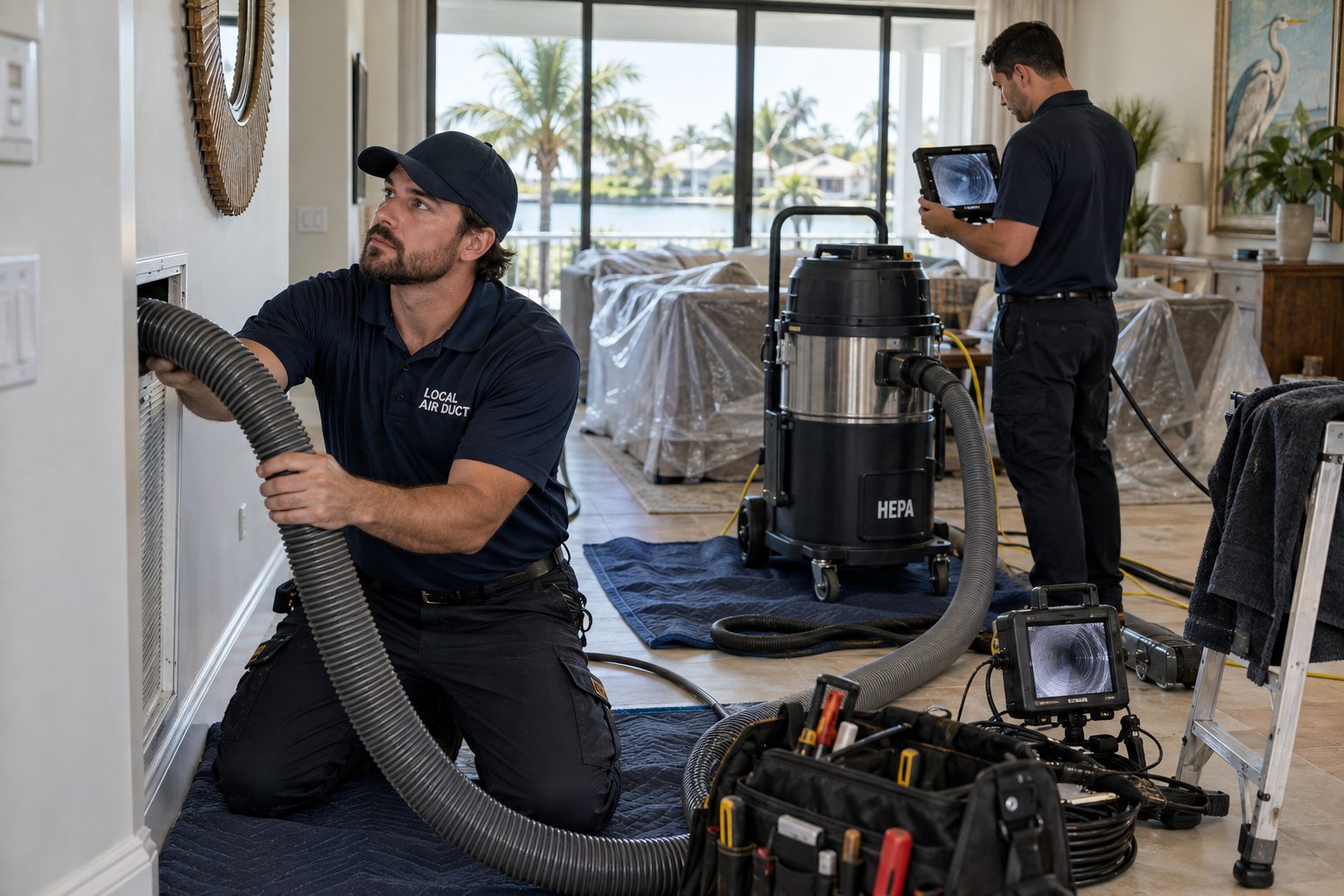
Duct cleaning is not just vacuuming the vent covers. A proper job creates negative pressure in the system so loosened debris is pulled toward a collection point rather than pushed into the living space. Technicians then agitate the duct surfaces with brushes, air tools or similar equipment while the vacuum runs, so dust is dislodged and carried away.
Registers and grilles are removed and cleaned, and the area around them is protected. Return paths and the main trunk lines get attention along with the branch runs. Where the air handler is accessible, the cabinet, blower and evaporator coil may also need work, which is covered in more detail in the coil and blower cleaning service description.
At the end, the system should be checked rather than simply switched off. Air should move normally from the vents, covers should be seated properly, and any access points cut into the ducts should be closed up neatly. You should be able to see before and after photos that show the same spots, not just a clean vent cover.
Cleanliness inside the duct is hard to judge from a register opening, which is why photos matter. A photo taken from the same angle before and after, with the same lighting, shows whether the duct wall changed. If a provider only photographs the outside of a grille, ask for an interior view or a look at the access point. Honest documentation protects both sides of the job. It also gives you something concrete to point to if you later want a second opinion from another technician, and it keeps the conversation about facts rather than impressions. Ask how the photos will be shared so you know what to expect.
Some offers sound attractive because they leave out most of the job. A very short visit for a whole house, a pitch that never mentions the return side, or a crew that arrives without a way to create suction are all worth questioning. If the plan does not explain how debris leaves the property, it may just be moving around inside it.
Be careful with scare tactics, too. Showing you a pile of dust and calling it dangerous, or claiming that mold is present without any inspection evidence, is not a service. Real concerns about mold or contamination need a careful look and often separate testing, and a provider should be willing to say that plainly.
Finally, watch for pressure to decide on the spot. A sound provider can wait while you compare. If a company cannot put its scope and price into clear words, or becomes impatient with questions, that tells you how the rest of the relationship may go.
Price talk deserves the same calm treatment. Compare what each quote includes rather than only the total, because two numbers that look different may describe very different amounts of work. Ask whether registers, returns, the coil and the blower are included, and whether access cuts or repairs would be extra. A clear list of inclusions is worth more than a low looking figure with gaps.
A single family home with one air handler and a two story layout is a different job from a ground floor condo with a closet unit, and both differ from a small office or a restaurant. The principles stay the same, but access, equipment and the amount of time needed change. Say what kind of property you have so the plan fits it.
Occupied properties need extra thought. Furniture, flooring and pets all affect how the crew sets up. Condos and townhomes may also have building rules about work hours, elevators or contractor access, and those rules vary, so ask your association or property manager before booking.
Think about access to the air handler itself. A unit in a hall closet with a tight door is simple to reach, while one in a hot attic or a garage corner may need a ladder, clear floor space and a clear path. Mentioning stored boxes, narrow attic openings or shared mechanical rooms helps the provider arrive prepared rather than discovering the problem when the work should already be moving.
If the property is commercial, read about commercial duct systems, where larger air handlers, longer runs and business hours become part of the planning. And if you manage rentals or a seasonal home, mention that on the call as well, since vacancy and turnover change what you are likely to find.
Dirty ducts are sometimes a symptom rather than the problem. If a duct joint has separated, if insulation is wet or torn, or if a return is pulling air from an attic or wall cavity, cleaning will only help for a while. The dust will come back because the system keeps drawing it in.
That is why an inspection should look for leaks, loose connections and damaged sections. When those exist, the honest recommendation is to fix them, either before or together with the cleaning. You can read how that works on the duct repair and sealing page.
Insulation is a related topic. In warm climates, poorly insulated ducts in hot attics lose cooling and can sweat. If your inspection turns up bare or damaged runs, ask whether attic duct insulation belongs in the conversation. The goal is a system that stays clean because it is tight, not one that needs rescuing every season.
Be willing to hear that the answer is smaller than you expected. Sometimes the right recommendation is to clean only the return side and the blower, or to seal one failed joint and leave the rest alone. A provider who talks you down to the work the system needs is showing you the kind of judgment that makes the next call easier.
The advice here is general, and it applies across Broward County and nearby areas. For city specific notes, you can read the pages for places such as Fort Lauderdale, Pembroke Pines and Weston, or browse the full service area overview. These pages stay general and do not claim local facts that cannot be verified.
If your city is not on the list, do not assume you are outside the area. Call and describe where the property is. The phone conversation is the clearest way to learn whether a visit can be arranged.
Whichever page you start from, the same steps apply: describe the symptom, let the system be inspected, hear the scope and price in plain words, and expect before and after photos and a final check.
Because humid weather is common across the region, the same questions about moisture, musty smell and staining come up in almost every city. If you want to dig deeper into a related topic, the air duct cleaning service page gives the full picture of what is included and how the work is laid out.
A cleaning is a reset, not a permanent fix. Changing or washing filters on a regular schedule, keeping supply and return vents unblocked, and sealing obvious gaps will slow the return of dust. Ask which filter type suits your system, since a filter that is too dense can strain a blower that was not built for it.
Watch for changes. A new musty smell, rooms that stop cooling evenly, or dark staining around vents are early clues. So is a dryer that takes much longer than usual to finish a load. Each of these points to a different service, and catching them early usually keeps the job smaller.
Keep the photos and notes from the visit. They give you a baseline to compare against later, and they are useful if you ever need to explain the history of the system to an HVAC technician, a landlord or a buyer.
Schedule your next look before you forget. Many owners set a reminder to inspect the registers each cooling season and to check the dryer vent whenever drying times start to stretch. Small habits like these cost little and keep the next service smaller, simpler and easier to explain.
It usually means they serve your area, not that they sit around the corner. What matters more is whether they ask good questions, inspect the system before naming a scope, and explain the price before work begins. Call two or three providers and compare how clearly each one describes the job.
Not always. Cleaning makes sense when you can see dust or staining at the vents, smell something musty, have finished a renovation, or bought a home with an unknown history. If nothing looks wrong, an inspection can tell you whether cleaning is needed or whether you can wait.
They need access to the registers and returns, the air handler, and any attic or closet space where ducts run. Tell the person on the phone about locked rooms, pets, stored belongings and tight spaces so the plan accounts for them before the visit.
No. The dryer vent is a separate exhaust path from the dryer to the outdoors. It is often cleaned during the same visit when the customer asks, but it is its own service with its own scope, so mention it when you call if it concerns you.
You should receive before and after photos of the same areas, plus a final check of the system. Registers should be seated properly, airflow should feel normal, and any access openings should be closed. If something is unclear, ask to see the photos again.
Then the plan should change. Leaks, disconnected joints or wet insulation need repair, and cleaning alone would not hold. A good provider will show you what was found, explain the options, and let you decide before any additional work begins.
Website content was prepared with AI assistance and reviewed for clarity. Service recommendations depend on an on-site assessment.